
Key Takeaway: The safest way to handle an emergency tyre replacement is to avoid changing it yourself on a live roadway. Slow down gradually without braking hard, pull into a designated refuge area or hard shoulder, activate your hazard lights, exit safely via the passenger side, and call a professional 24/7 mobile tyre fitting service to resolve the issue with heavy-duty equipment.
Immediate Vehicle Control: The Golden Rules of Pulling Over
Experiencing a sudden tyre blowout or severe puncture while driving is startling, but your immediate reaction dictates how safely the situation unfolds. The absolute first priority is maintaining control of the vehicle and securing a safe location to stop, especially if you are traveling at speed on major South Coast routes like the M27, M3, or A31.
- Do Not Brake Suddenly
Human instinct tells us to slam on the brakes when we hear a loud pop or feel the car pull sharply. This is the most dangerous thing you can do. Hard braking shifts the vehicle’s weight forward and can cause a total loss of steering control. Instead, take your foot off the accelerator completely and allow the engine to naturally slow the car down.
- Grip the Steering Wheel Firmly
A blown tyre will cause your vehicle to drag heavily toward the side of the flat. Keep both hands firmly on the wheel and make small, smooth steering corrections to keep the car tracking straight in your lane as it decelerates.
- Navigate to a Safe Zone
As your speed drops to a manageable level, immediately activate your hazard lights to warn the drivers behind you. Your goal is to get the vehicle as far away from live traffic as possible.
- On Motorways (M27 / M3): Aim for the hard shoulder or a designated Emergency Refuge Area (ERA).
- On Rural Routes (e.g., New Forest): Continue driving at a very slow crawl until you reach a lay-by, a straight stretch of road with high visibility, or a wide grass verge.
Safety Note: It is always better to completely destroy a flat tyre and even risk damaging an alloy wheel than it is to stop on a blind bend or in a live lane of traffic. A damaged rim can be resolved with professional mobile wheel repair, but a roadside collision cannot.
- Exit the Vehicle Safely Once parked, turn your steering wheel sharply away from the road (so if your car is hit from behind, it is pushed into the verge, not back into traffic). Ensure all occupants exit the vehicle exclusively through the passenger-side doors, keeping everyone far away from passing vehicles. Move behind the safety barrier or up onto the embankment to wait.
The Pre-Replacement Roadside Safety Checklist
Before anyone attempts to inspect or change a flat tyre, you must assess the immediate environment. A vehicle weighs upwards of two tonnes; raising it in an uncontrolled environment is inherently dangerous.
Run through this rapid safety matrix before making your next move:
| Hazard Category | Safety Check | Recommended Action |
| Ground Stability | Is the surface flat and solid (tarmac/concrete)? | Scissor jacks will sink into soft grass or mud, causing the car to collapse. If you are not on solid ground, do not attempt to lift the vehicle. |
| Visibility & Traffic | Are you on a blind bend, a narrow rural road, or a live motorway hard shoulder? | If passing traffic is within a few feet of your vehicle, it is too dangerous to attempt a DIY repair. Wait behind the safety barrier for a professional. |
| Passenger Safety | Are passengers still inside the vehicle? | A car must be completely empty before being jacked up. Any sudden movement inside the cabin can shift the weight and topple the jack. |
| Tools & Equipment | Do you have a physical spare tyre, a high-visibility jacket, and a warning triangle? | Modern inflation kits are useless for severe blowouts. If you lack the proper equipment, call for emergency roadside assistance. |
Why DIY Tyre Changes are Increasingly Dangerous (Expert Insight)
Historically, changing a flat tyre was considered a standard motoring skill. Today, however, the landscape of vehicle design and road traffic has changed drastically.
According to Abu Bakar, Lead Technician at ABS Tyres with over 15 years of hands-on roadside experience, attempting a DIY wheel change on a modern roadway carries severe risks.
The Illusion of the Spare Tyre
Most modern vehicles are no longer sold with a physical spare wheel in the boot. Instead, manufacturers provide chemical inflation kits to save weight and space. “These kits might temporarily seal a tiny nail hole, but they are completely useless against a sidewall puncture or a high-speed blowout,” explains Abu Bakar. If the tyre’s structural integrity is compromised, an inflation kit will just leave you stranded with a messy, unrepairable tyre.
The Danger of Flimsy Scissor Jacks
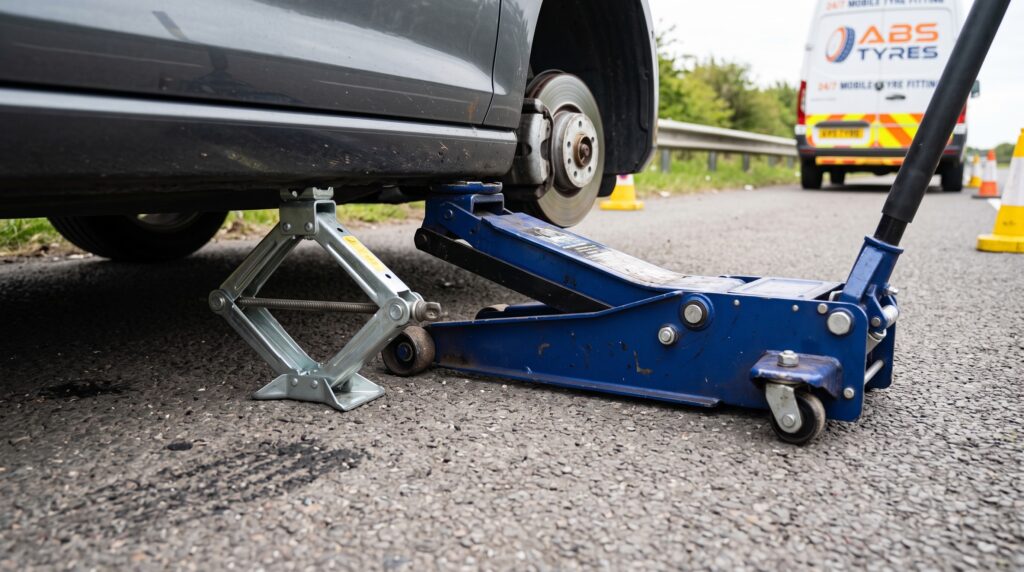
The standard scissor jack provided in older cars is designed for emergency use on perfectly flat, solid concrete. Using one on the slightly sloped, uneven tarmac of an M27 motorway hard shoulder—with heavy goods vehicles roaring past just feet away—is a recipe for disaster. The aerodynamic drag from a passing lorry is often enough to topple a car off a basic jack.
Locking Wheel Nut Complications
If your vehicle has alloy wheels, it is secured with a locking wheel nut to prevent theft. To change the tyre, you need the specific locking wheel nut key. If this key is lost, damaged, or simply over tightened by a previous garage, a standard lug wrench will not remove it. Forcing it will strip the nut entirely. Professional technicians use specialized heavy-duty extraction tools for safe locking wheel nut removal without damaging the expensive alloy rim.
The Safest Route: 24/7 Mobile Tyre Fitting
Ultimately, the safest way to replace a blown or punctured tyre is to remove yourself from the physical equation entirely. Changing a wheel on the roadside is no longer just a mechanical task; it is a serious health and safety hazard.
By utilizing a professional 24/7 mobile tyre fitting service, you stay safely out of harm’s way while experts handle the heavy lifting. ABS Tyres provides a superior emergency response across Southampton and the South Coast by prioritizing speed and safety:
- Rapid Dispatch: Unlike national chains that route you through slow call centers, ABS Tyres connects you directly with the fitter, allowing for a 45 to 60-minute ETA.
- Commercial & EV Ready: The mobile vans operate as fully functioning garages, carrying the heavy-duty hydraulic jacks and high-torque tools required for heavy electric vehicles and commercial van tyres.
- Complete On-Site Resolution: Whether you need a simple mobile puncture repair or a full tyre replacement, the vans are stocked with a range of premium and budget tyres to resolve the issue right where you are parked.
Frequently Asked Questions
Is it safe to change a tyre on the motorway hard shoulder?
No. Attempting a DIY tyre change on the hard shoulder of a busy motorway like the M27 or M3 is incredibly dangerous due to high-speed traffic and the aerodynamic pull of passing HGVs. You should exit the vehicle via the passenger side, stand safely behind the crash barrier, and call for emergency roadside assistance.
What if my car doesn’t have a spare tyre?
This is extremely common in modern vehicles, which often only supply temporary inflation kits. If you suffer a blowout or sidewall puncture, an inflation kit will not work. A mobile tyre fitter will arrive with a brand-new, correctly sized replacement tyre and fit it directly to your vehicle on-site.
How fast can an emergency mobile tyre fitter reach me?
When you contact ABS Tyres directly, the target response time is a 45 to 60-minute ETA across our core service areas, including Southampton, Winchester, and the New Forest.
Don’t risk your safety on the roadside.
ABS Tyres delivers rapid, professional 24/7 mobile tyre fitting across the South Coast with zero call-center delays. If you are stranded, move to a safe location and call our emergency dispatch at 023 8155 0102, or drop your exact location via WhatsApp for an instant quote and a 45-60 minute ETA. Payment is easy and secure with our on-board mobile card terminals.