
If you discover a nail in your tyre, do not pull it out. The object is currently acting as a plug, sealing the hole and keeping the pressurized air inside. Removing it will cause rapid deflation, leaving you stranded. Leave the nail in place, avoid driving on it, and call a professional mobile puncture repair unit to safely extract it and permanently fix the tyre.
The “Plug” Effect: Why the Nail is Keeping You Afloat
Spotting a glint of metal in your tyre tread is a frustrating experience, and human instinct almost always screams at us to pull the foreign object out. However, giving into that urge is the worst mistake you can make when dealing with a puncture.
When a nail or screw penetrates a tyre, the thick layers of rubber immediately clamp down tightly around the shaft of the object. While it has broken the airtight seal of the inner liner, the nail itself acts as a makeshift plug. It temporarily blocks the air from escaping, which is why motorists can sometimes drive for days without realizing they have suffered a puncture.
If you grab a pair of pliers and pull that nail out, you are removing the only thing keeping your tyre inflated. The pressurized air inside will immediately rush out of the newly opened hole, resulting in a sudden, completely flat tyre. Instead of being able to carefully plan a repair, you will find yourself instantly stranded on your driveway or at the roadside.
If you are unsure whether the nail has completely penetrated the rubber or is just resting in the tread block, do not test it by pulling it. You can review our diagnostic guide on How Do I Know If I Have a Car Tyre Puncture? to safely inspect the wheel. If the object is deeply embedded, leave it exactly where it is.
The BS AU 159 Standard: Can Your Tyre Be Saved?
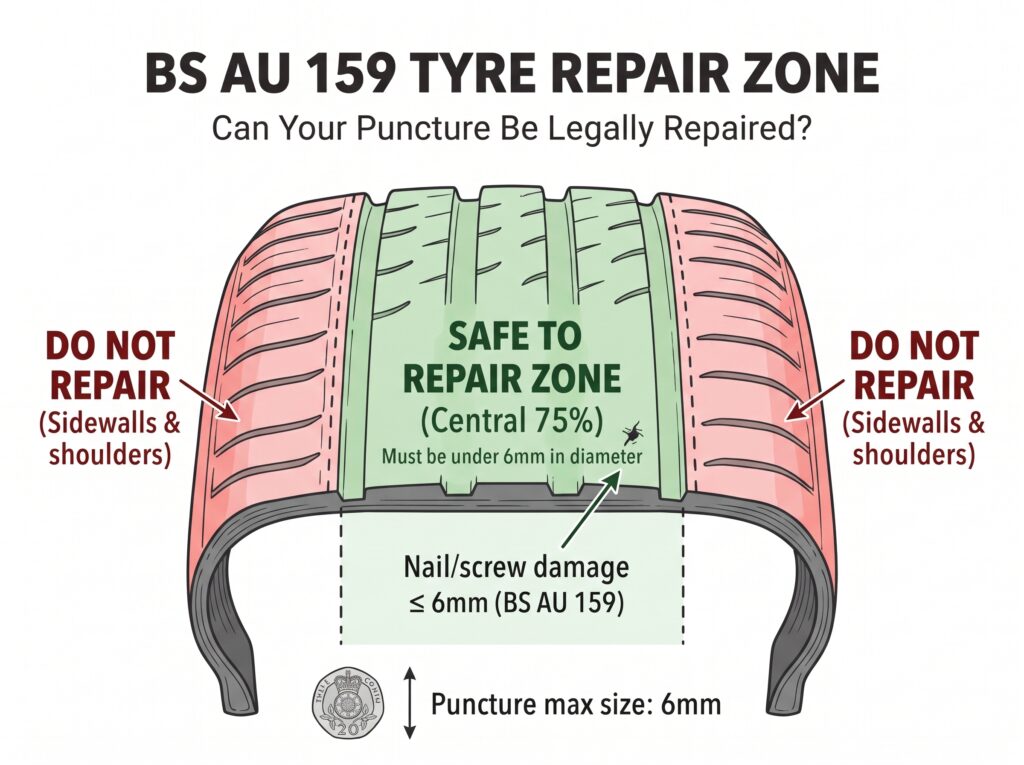
In the UK, tyre repairs are strictly governed by the British Standard (BS AU 159) to guarantee maximum driver safety. Just because you have a nail in your tyre does not automatically mean the tyre is ruined, but it must pass a rigorous safety assessment before it can be legally repaired.
For a puncture to be considered safe to fix, two primary conditions must be met:
- Location: The puncture must be located squarely within the “minor repair area,” which is the central three-quarters of the tyre’s tread.
- Size: The diameter of the damage caused by the nail or screw must not exceed 6mm.
If the nail has punctured the sidewall or the curved outer shoulder of the tyre, a repair is strictly prohibited. The sidewall flexes continuously as you drive; a patch applied to this area will quickly detach, leading to a high-speed blowout.
In these cases, the tyre is legally unrepairable and must be completely replaced. If this happens, you will need to utilize a 24-hour emergency tyre fitting service so a technician can bring a fresh replacement tyre directly to your location.
The Dangers of DIY Extraction (Expert Insight)
Even if the puncture appears to fall within the safe repair zone, attempting to pull the nail out yourself or using a cheap DIY string-repair kit is a massive gamble.
According to Abu Bakar, Lead Technician at ABS Tyres with over 15 years of hands-on roadside experience, improper extraction often causes irreversible damage.
“A nail or screw rarely penetrates the rubber at a perfectly straight 90-degree angle,” Abu Bakar explains. “If you try to yank the object out at the wrong angle using pliers, you can easily tear the tyre’s internal wire cords. What would have been a fast, inexpensive mobile puncture repair suddenly becomes a mandatory full tyre replacement because the internal structure has been destroyed.”
Furthermore, pulling the nail, letting the tyre deflate, and then attempting to swap it for your spare wheel introduces new mechanical risks. Drivers frequently encounter overtightened lug nuts or missing security keys when attempting a DIY wheel change at the roadside.
Instead of wrestling with a wheel brace and risking stripped bolts, it is infinitely safer to let professionals handle the heavy lifting, including safe, damage-free locking wheel nut removal and puncture patching.
Your Immediate Action Plan
When you discover a nail or screw embedded in your tyre, your priority is preventing further damage. Follow these three immediate steps to protect the wheel and ensure the highest chance of a successful, low-cost repair:
- Do Not Drive on the Tyre: Every revolution of the wheel grinds the head of the nail into the tarmac, pushing the sharp shaft deeper into the tyre’s inner carcass. This widens the puncture hole, often stretching it beyond the 6mm legal repair limit. If the nail is driven too deep, it can also scratch the inside of your expensive alloy rim.
- Monitor the Tyre Pressure: If you have a tyre pressure gauge, check the PSI. If the tyre is already visibly flat, do not attempt to inflate it and drive, as this will destroy the sidewall. If it is still holding air, leave the vehicle parked safely on your driveway or in a lay-by.
- Call the Experts for On-Site Extraction: There is no need to risk a slow, nerve-wracking drive to a local garage. By utilizing professional mobile tyre services, a fully equipped technician will travel directly to your location. They will carefully extract the nail, assess the internal damage, and if it passes safety standards, vulcanize a permanent patch from the inside out—all without you having to lift a finger.
Frequently Asked Questions
How long can I leave a nail in my tyre?
You should never leave a nail in your tyre for an extended period, even if it is not rapidly losing air. As you drive, the metal object shifts and damages the internal structure. Furthermore, moisture from the road can seep in through the puncture hole, causing the tyre’s internal steel belts to rust and snap, leading to an eventual blowout. Get it inspected immediately.
Will a nail always cause a flat tyre?
Not always. Sometimes, a short nail or a small screw will embed itself horizontally into the thick rubber of a tread block without actually piercing the tyre’s airtight inner liner. However, the only way to safely verify this is to have a professional extract the object in a controlled environment.
Can you repair a tyre with a screw in it on my driveway?
Yes. Our mobile vans operate as fully functioning mobile garages. If the screw has caused a puncture that meets BS AU 159 safety standards (under 6mm in the central tread area), our technicians will safely remove the tyre from the wheel, apply a permanent internal patch and plug, rebalance the wheel, and fit it right back onto your car on your driveway.
Spotted a nail in your tyre? Leave it exactly where it is and let us handle it.
ABS Tyres provides expert, damage-free mobile puncture repair directly to your driveway, workplace, or the roadside across Southampton and the South Coast. We aim for a rapid 45-60 minute ETA to get you moving again safely.
Call our dispatch hotline immediately at 023 8155 0102, or send us your exact location via WhatsApp for an instant response. We accept secure contactless payments at the roadside.